 Mindelo Life
Mindelo Walking Tour: A Self-Guided Route Through the Historic Centre
A self-guided walk through Mindelo's historic centre, stop by stop, with the real names and dates of every building on the way, ending above the roofs at the old fort.
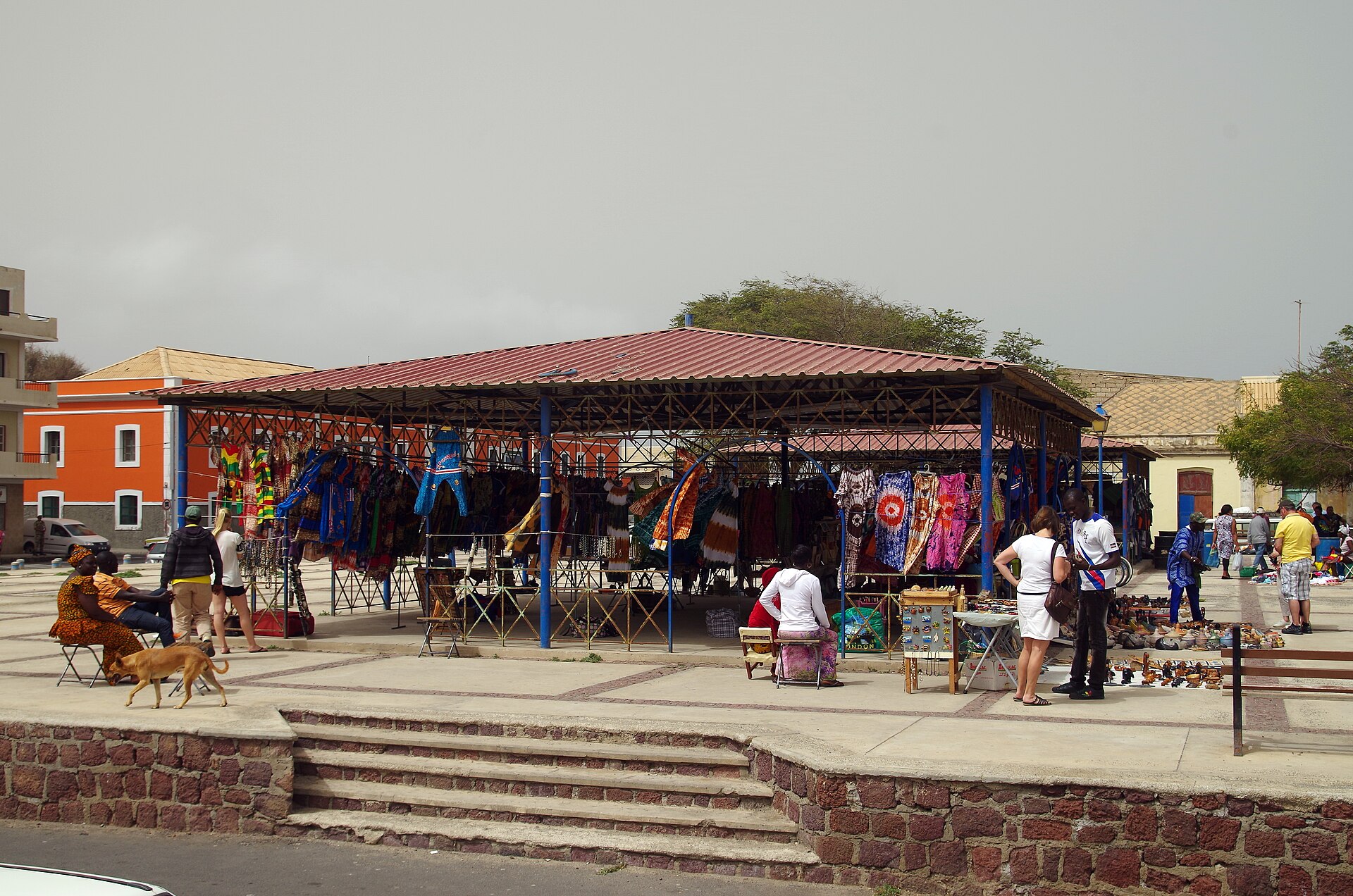 Photo: Balou46 (CC BY-SA 4.0) via Wikimedia Commons
Mindelo's historic centre was built small: two main axes along the waterfront, a ring of 19th-century buildings, and a hill fort above them. Many colonial buildings from the 19th and early 20th century survive, which makes the centre one of the most rewarding short walks in West Africa (Wikipedia: City center of Mindelo). This route orders the verified stops so the walk builds from the bay to the skyline and finishes with the best view of all. No guide is needed: every stop is public, named and dated.
One thing helps before you set off: Mindelo runs on two sets of names. The main shopping street is officially Rua Libertadores de África, but everyone calls it Rua de Lisboa, and the square formally registered as Praça Amílcar Cabral is universally the Praça Nova (Wikipedia: Mindelo; Inforpress, 22 September 2026). Both names appear below, exactly as locals use them.
Stop 1: the waterfront on Avenida Marginal
Start anywhere along the Avenida Marginal, the boulevard on Porto Grande bay, and let the city introduce itself: fishing boats, the marina pontoon and Monte Cara's profile across the water. The Diogo Afonso statue on the waterfront honours the navigator who sighted the island on 22 January 1462 (Wikipedia: Mindelo).
Stop 2: Praça Estrela and the Torre de Belém
At the southern end of the centre, Praça Estrela is the tree-lined square where the kiosks pour the morning's first coffee. Behind it on the water stands the Torre de Belém, built between 1918 and 1937 as a replica of Lisbon's defensive tower and now home to the city's sea museum (Wikipedia: City center of Mindelo; IPC). Fishermen unload at the Mercado de Peixe nearby, and mornings are the time to see it (the markets guide explains what is happening with its relocation).
Stop 3: up Rua de Lisboa
Turn inland and walk the shopping street slowly, because the buildings are the sight. On and around it stand some of the centre's oldest: the city hall, or Paços do Concelho, built between 1860 and 1873, and the Escola Jorge Barbosa, known as the Liceu Velho, built in 1873 as a governor's residence before becoming the island's first lycée (Wikipedia: City center of Mindelo). Look up as you go; the facades reward it.
Stop 4: the Mercado Municipal (1878)
The two-level Mercado Municipal of 1878 is still where the city buys its food, produce stalls below and the Cafe Verde on the upper floor. Out on the square, Praça Estrela's morning vendors sell mangoes and skillet-fried cachupa; the markets guide explains what to look for.
Stop 5: Palácio do Povo and the pro-cathedral
Continue to the Palácio do Povo, the former Government Palace built in 1874 and expanded between 1928 and 1934, and the pro-cathedral Igreja Nossa Senhora da Luz, built in 1862 as the seat of the diocese (Wikipedia: Mindelo). The Palácio's ground floor currently hosts a Carnival exhibition, a useful preview of the city's biggest party (Wikipedia: Palácio do Povo; see our Carnival guide).
Stop 6: Praça Nova and the CNAD
Praça Amílcar Cabral, the Praça Nova, is the north square every Mindelense considers the city's most emblematic. Its fountain, kiosk and bandstand are at the centre of a restoration project announced in 2026; as of September that year the works were embargoed by the heritage authority, so expect hoardings and take the square as you find it (Inforpress, 22 September 2026). On the square stands the CNAD, the national centre for art, crafts and design, whose new building opened in 2022 (Inforpress, 24 July 2025); more in the museums guide.
Stop 7: the Cesária Évora sites
Two Cesária stops close the loop. The Municipal Library carries the portrait the artist Vhils carved into its wall in 2019, her face emerging from the plaster itself; stand close, because the image is cut, not painted (vhils.com). A few streets away, the Núcleo Museológico Cesária Évora at Rua Guerra Mendes 24, opened in 2015, keeps her records, dresses and photographs (IPC). The Centro Cultural do Mindelo, in the former Customs House of 1858 to 1860, is a short walk back towards the water (turismo.cv).
Stop 8 (the finish): Fortim d'El-Rei
Save the climb for last. Out of the centre's northern edge, in the Fortinho neighbourhood, stands Fortim d'El-Rei, the fortress built in 1852 to defend the bay. It has been out of military use since the 1930s and is gently decayed, but the panorama over the red roofs, the bay and Monte Cara is the classic Mindelo view (Wikipedia: Fortim d'El-Rei). Time the climb for the end of the afternoon and the sunset guide takes over from there.
Practical notes
The route is flat except the fort climb and fits comfortably into a morning with stops; the free things to do guide adds zero-cost detours, and the cafés guide marks where to break for coffee. Guided options exist, but this route needs none of them.
Video: walking the same streets
A ground-level walk through the centre, useful to preview the route above.
Frequently asked questions
Is Mindelo walkable?
Yes: the historic centre is a few blocks wide and flat, with the fort as the only climb. The waterfront, squares, market and museums in this route all sit within a short walk of each other.
How long does the walking tour take?
About two to three hours with stops, or a full morning if you enter the museums, whose published hours are in our museums guide.
What should I not miss?
If you cut anything, keep the market, the Vhils portrait and the fort view: one of each of the city's food, art and geography.
Sources
- Wikipedia: City center of Mindelo, for the centre's geography, squares and building dates.
- Wikipedia: Mindelo, for city history and landmark dates.
- Inforpress, 22 September 2026, for the Praça Nova restoration status.
- Inforpress, 24 July 2025, for the CNAD reopening anniversary.
- Instituto do Património Cultural and vhils.com, for the museum and the mural.
Image and video credits
- Hero photograph: CV-mind-pr-estrela-03 by Balou46, via Wikimedia Commons, CC BY-SA 4.0.
- Embedded video: Mindelo, Cabo Verde | Walking Tour by Street Level Reality, displayed through a direct lazy-loading youtube-nocookie.com iframe.
